
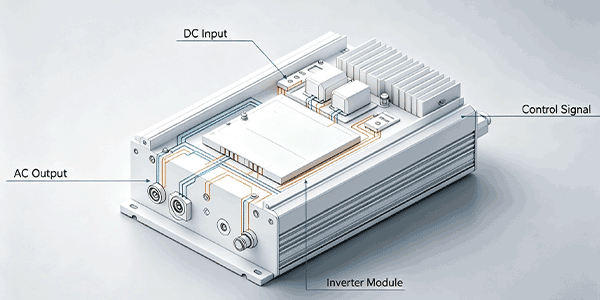
Converts high‑voltage DC power from traction battery into AC power for drive motor; supports energy‑recovery inversion. Core power component of electric‑drivetrain system.
Top‑10 Global Brands
Bosch, ZF, Continental, BorgWarner, DENSO, Vitesco Technologies, Magna, Valeo, Infineon (power‑semiconductor solution), Nidec. Global suppliers provide automotive traction inverters for BEV and PHEV platforms, adopting IGBT or SiC MOSFET power semiconductor devices for high‑efficiency power conversion.
Top‑10 Chinese Brands
Inovance United Power, BYD Fudi Power, UAES, Huawei Digital Energy, Jingjin Electric, Desay SV, Everauto, HASCO E‑drive, CRRC Times Electric, E‑OCT. Domestic suppliers supply standalone inverters and highly‑integrated e‑drive assemblies for domestic and overseas OEMs.
Technical Analysis
Structure
Vehicle traction inverter is composed of power semiconductor modules (IGBT or SiC‑MOSFET), gate‑drive board, main‑control PCB, DC‑link filter capacitors, three‑phase output busbars, water‑cooling cooling circuit, metal housing and high‑voltage connectors. Receiving torque command from VCU, it converts high‑voltage DC from traction battery into three‑phase AC for drive motor. During coasting or regenerative braking, it performs reverse energy‑recovery inversion and charges traction battery with motor‑generated electricity.
Application
Converts high‑voltage DC power from traction battery into AC power for drive motor; supports energy‑recovery inversion. Core power component of electric drivetrain system.
Manufacturing Challenges
First, thermal‑management design for power semiconductors under large‑current operating conditions. Second, low‑stray‑inductance busbar layout for power loop to suppress voltage spike. Third, power‑device soldering process to reduce thermal resistance. Fourth, signal isolation between gate‑drive board and main‑control board for high‑speed signal transmission. Fifth, mechanical reliability under wide‑temperature range and heavy vehicle vibration. Sixth, multi‑layer protection logic for over‑current, over‑voltage and over‑temperature fault conditions.
Required Quality Documents
IATF‑16949 certification, APQP documents, DFMEA/PFMEA, control plan, full‑set PPAP, power‑cycle durability test report, water‑cooling reliability report, EMC compliance report, functional‑safety assessment report.
Vehicle‑level Performance Impact
Inverter directly defines motor torque output capacity and torque‑response speed. Inverter power loss determines vehicle energy consumption and cruising range. Power‑semiconductor over‑temperature triggers power‑derating protection and limits acceleration performance. Severe inverter failure will lead to propulsion loss.